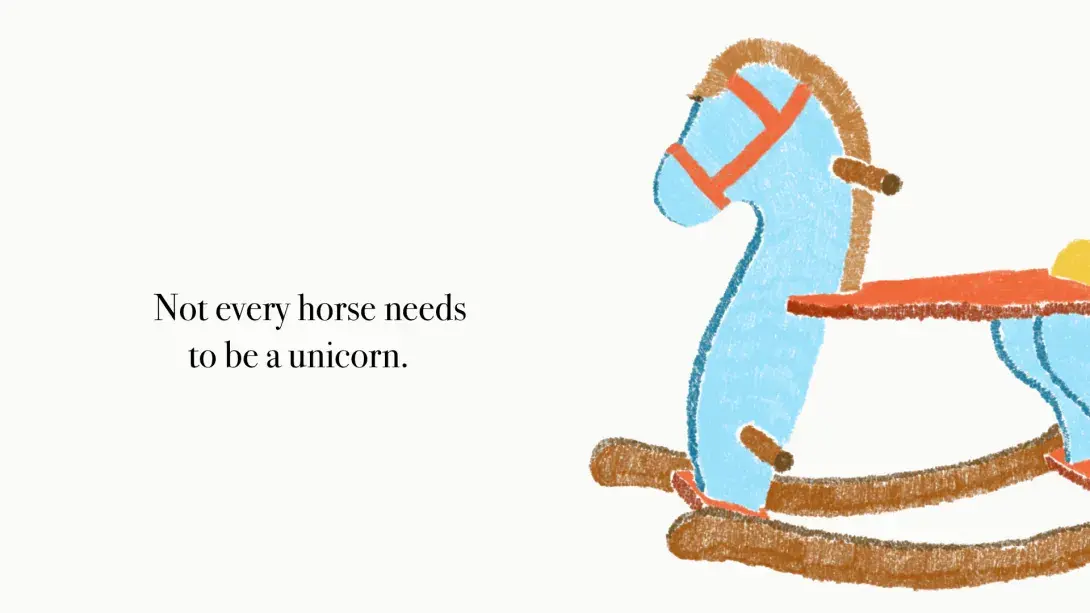
Not Every Horse Needs to be a Unicorn
2 March 2026
A concept is the foundation of any and every design process. Something we craft painstakingly to evoke that emotive response from the world. When I was in college, I always heard, “If you have a strong concept, everything else will follow.” That still holds true, but the emphasis on generating a concept really varies depending on what you’re working on.
Often, when we try to establish a concept, it might be aspirational. Imagine, in a presentation, you say: “The colours represent the hues of the rising sun evoking the emotion of new hope for your tea brand.” The client looks at you with an expression that says all the orange shades look the same, or even better, “Maza nahi aa raha!” (It’s not hitting the spot.)
Conceptualisation and brainstorming are super fun until the client bombards you with a line of enquiry about the practicality of things. The same concept you hold in high regard can mean very less to its users. To look for positivity in the otherwise demotivating journey, the concept will surely help you in setting constraints to your process. Just reframe the narrative for your client and you are sorted. Note for freshers: While being aspirational is a good thing (who doesn’t like to dream big?), the real world might burst your bubble. Don’t worry, it burst mine too. Not always calling a horse a unicorn is going to help. Maybe just let the horse be a horse and it will win you the race. What might also be helpful in crafting a beautiful narrative for your design, is to consider and set practical constraints. What I mean is: materiality, target audience, or (very practically) the budget will guide you.
I’ve also observed a difference when designing for a brand versus another domain. Brands demand a certain kind of narrative, which allows us to be all kinds of dreamy, poetic, utopic, dystopic you name it, and you can work with that. It doesn’t work the same way with all projects. It may happen that the concept is thwarted, not realized by the client, or even made fun of for being “too up in the air.” To illustrate what I have written, a client came in with a requirement of a wayfinding system. The space was a combination of outdoor and indoor which were quite transient in nature. Interpreting the sound of these spaces into signage form seemed like a nice concept. Something that could also be translated into the visual language. Alas, the client rejected it by calling it something that came straight out of an amusement park. Not so amusing hearing this after spending hours on it, eh? So, does spending hours researching and conceptualising really lay the foundation? While designers try to put meaning in all things, sometimes it’s important to note how much we are really emphasising on it.
In certain cases, a concept is also diluted by the time it reaches the contractor working on site (your cue to read Chinese Whispers in Design). In such cases, it might be mindful to create concepts or versions of concepts that are digestible by all the stakeholders in your project. In short, your project should be like water, adaptable for all stones and logs that are in the way.
Fair warning, some clients seem to be only interested in the look and feel, not the logic behind it. Hence, your challenge is: how would you make your concept digestible rather, acceptable? So, next time you sit down to ‘conceptualise’, ask yourself: Am I designing a narrative only for myself, or for everyone involved in bringing it to life?
-Sakshi, Sarg Design Studio