Why is Simplicity Harder Than It Seems?
28 April 2026

Every designer has heard the quote from Dieter Rams which goes something like this, ‘Good design is as little design as possible. Less, but better’. And if you're like me, you've probably pondered over this quote for an unreasonable amount of time, trying to decipher its true meaning, because obviously, understanding design wisdom requires dramatic levels of soul-searching. Surely, it doesn't mean designing less and delivering half-baked ideas (or at least, I hope that’s not what it means). So how should we interpret it? Ironically enough, the answer to having a simple design, is not that simple.
As freshers, we often get lost in the minute details, spending hours coloring the pixels that no one else can see or contemplating over two shades of ‘almost identical’ greys and let’s not forget the chaos over the background of a render being 1% lighter or darker. Amongst all these details, we freshers often lose sight of the bigger picture.
Simplicity is often mistaken with minimalism since they can be visually similar at times. Be that as it may, when it comes to function, removing features in an attempt to make a design ‘simpler’ can often backfire, making the product a watered-down version of what it could’ve been instead. Imagine a keyboard with no distinctive form for the buttons, no labels, and just a cryptic arrangement that you’re somehow supposed to intuitively understand. That’s not really minimalism, let alone simplicity.
On the flip side, some designers go overboard, stuffing products with every possible feature in an attempt of creating an illusion of them being more useful. More often than not, this results in a product that is so overwhelming for the user, that it loses its appeal. The user is left wondering: ‘Is this a gadget, or would I need a PhD to operate it?’
The key is to tread on that fine line between the two- remove what’s unnecessary but keep just enough to ensure clarity and functionality.
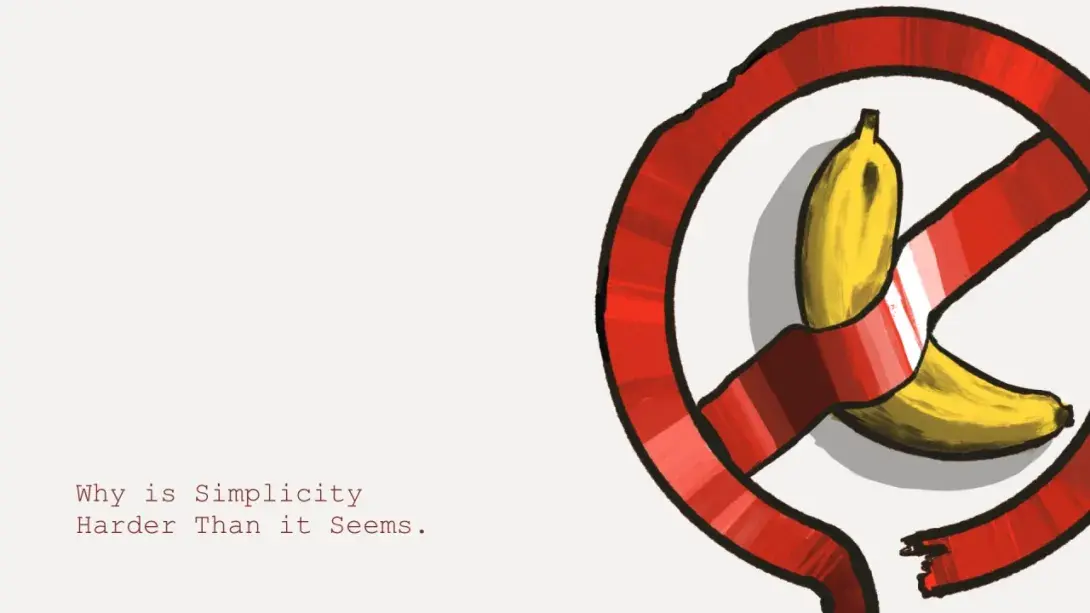
Here’s a thought: simple design is hard because we often don’t think about it enough. It’s easy to assume that a clean layout, a straightforward extrusion, or a minimalist poster requires less effort. After all, it’s just a few shapes and some negative space, right? Wrong. Achieving simplicity requires extreme attention to detail. Every element in a simple design must be intentional. You don't just throw bananas on the wall and see what sticks; this isn't modern abstract art (I really hope you all get that reference).
Simplicity and complexity are often seen as opposites, but in reality, they are two sides of the same coin. What truly sets them apart is how the final product is showcased. What does this tell us? That the process of reaching simplicity can be messy, chaotic, and borderline maddening. In the real world, the design process is not a straight path, it is a game of snakes and ladders where you must go back sometimes to climb up a bigger ladder instead.
The way I interpreted Dieter Rams' quote is- that details absolutely matter, but showcasing every small detail individually isn’t the goal. Instead, the aim is to seamlessly merge a select few elements into a cohesive whole, where no single part demands attention, but everything functions in perfect harmony.
Here is a system that has worked well for me- Think of everything possible during initial ideation and explorations and get it out of your system, let your imagination run wild, sketch every ridiculous idea that crosses your mind. Put it all out there like a brainstorming session with no budget constraints. And once you've completely exhausted your creative chaos, you can then do permutations and combinations while thinking of feasibility, requirements of the client, functionality etc. Work backwards from there, subtract. Not because a simple design demands it, but because what remains is what truly matters.
In the end, the best designs aren’t the ones that look the simplest or cleanest, they’re the ones that ‘feel’ simple and effortless for the consumer to use. A well-designed product isn’t the one that screams about its complexity, neither is it the one which appears simple visually; It is the one that just simply works.
- Rohit, Sarg Design Studio